
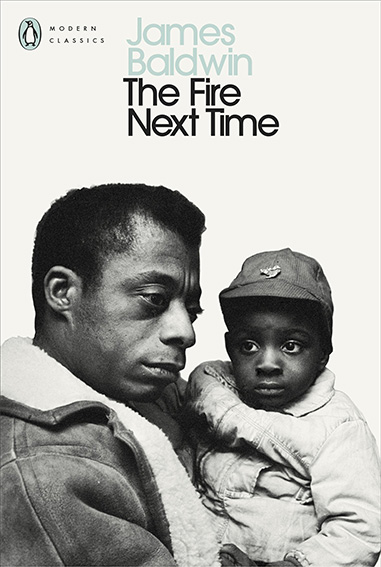
 James Baldwin's "My Dungeon Shook"—an open letter to his nephew—displayed the eloquence and brutal honesty that made him one of the most acclaimed writers of the twentieth century. Baldwin (1924-1987) was born into a family in Harlem and was a pentecostal preacher as a teen. His first novels, Go Tell It on the Mountain (1953) and Giovanni's Room (1956), were written while he lived in Paris. In 1957, Baldwin returned to the United States, where he earned his reputation as one of the most trenchant thinkers on the topic of American race relations. His 1963 work, The Fire Next Time, from which "My Dungeon Shook" is excerpted, was prophetic for its warning of widespread turmoil and violence in American cities during the 1960s.
Dear James:
I have begun this letter five times and torn it up five times. I keep seeing your face, which is also the face of your father and my brother. Like him, you are tough, dark, vulnerable, mood—with a very definite tendency to sound truculent because you want no one to think you are soft. You may be like your grandfather in this, I don’t know, but certainly both you and your father resemble him very much physically. Well, he is dead, he never saw you, and he had a terrible life; he was defeated long before he died because, at the bottom of his heart, he really believed what white people said about him. This is one of the reasons that he became so holy. I am sure that your father has told you something about all that. Neither you nor your father exhibit any tendency towards holiness: you really are of another era, part of what happened when the late E. Franklin Frazier called “the cities of destruction.” You can only be destroyed by believing that you really are what the white world calls a nigger. I tell you this because I love you, and please don’t forget it.
I have known both of you all your lives, have carried your Daddy in my arms and on my shoulders, kissed and spanked him and watched him learn to walk. I don’t know if you’ve known anybody from that far back; if you’ve loved anybody that long, first as an infant, then as a child, then as a man, you gain a strange perspective on time and human pain and effort. Other people cannot see what I see whenever I look into your father’s face as it is today are all those other faces which were his. Let him laugh and I see a cellar your father does not remember and a house he does not remember and I hear in his present laughter his laughter as a child. Let him curse and I remember him falling down the cellar steps, and howling, and I remember, with pain, his tears, which my hand or your grandmother’s so easily wiped away. But no one’s hand can wipe away those tears he sheds invisibly today, which one hears in his laughter and in his speech and in his songs. I know what the world has done to my brother and how narrowly he has survived it. And I know, which is much worse, and this is the crime of which I accuse my country and my countrymen, and for which neither I nor time nor history will ever forgive them, that they have destroyed and are destroying hundreds of thousands of lives and do not know it and do not want to know it. One can be, indeed one must strive to become, tough and philosophical concerning destruction and death, for this is what most of mankind has been best at since we have heard of man. (But remember: most of mankind is not all of mankind.) But it is not permissible that the authors of devastation should also be innocent. It is the innocence which constitutes the crime.
Now, my dear namesake, these innocent and well-meaning people, your countrymen, have caused you to be born under conditions not very far removed from those described for us by Charles Dickens in the London of more than a hundred years ago. (I hear the chorus of the innocents screaming, “No! This is not true! How bitter you are!”—but I am writing this letter to you, to try to tell you something about how to handle them, for most of them do not yet really know that you exist. I know the conditions, under which you were born, for I was there. Your countrymen were not there, and haven’t made it yet. Your grandmother was also there, and no one has ever accused her of being bitter. I suggest that the innocents check with her. She isn’t hard to find. Your countrymen don’t know that she exists, either, though she has been working for them all their lives.)
Well, you were born, here you came, something like fourteen years ago: and though your father and mother and grandmother, looking about the streets through which they were carrying you, staring at the walls into which they brought you, had every reason to be heavyhearted, yet they were not. For here you were, Big James, named for me—you were a big baby, I was not—here you were: to be loved. To be loved, baby, hard, at once, and forever, to strengthen you against the loveless world. Remember that: I know how black it looks today, for you. It looked bad that day, too, yes, we were trembling. We have not stopped trembling yet, but if we had not loved each other none of us would have survived. And now you must survive because we love you, and for the sake of your children and your children’s children.
This innocent country set you down in a ghetto in which, in fact, it intended that you should perish. Let me spell out precisely what I mean by that, for the heart of the matter is here, and the root of my dispute with my country. You were born where you were born, and faced the future that you faced because you were black and for no other reason. The limits of your ambition were, thus, expected to be set forever. You were born into a society which spelled out with brutal clarity, and in as many ways as possible, that you were a worthless human being. You were not expected to aspire to excellence: you were expected to make peace with mediocrity. Wherever you have turned, James, in your short time on this earth , you have been told where you could go and what you could do (and how you could do it) and where you could do it and whom you could marry. I know that your countrymen do not agree with me about this, and I hear them saying “You exaggerate.” They do not know Harlem, and I do. So do you. Take no one’s word for anything, including mine—but trust your experience. Know whence you came. If you know whence your came, there is really no limit to where you can go. The details and symbols of your life have been deliberately constructed to make you believe what white people say about you. Please try to remember that what that believe, as well as what they do and cause you to endure, does not testify to your inferiority but to their inhumanity and fear. Please try to be clear, dear James, though the storm which rages about your youthful head today, about the reality which lies behind the words acceptance and integration. There is no reason for you to try to become like white people and there is no basis whatever for their impertinent assumption that they must accept you. The really terrible thing, old buddy, is that you must accept them. And I mean that very seriously. You must accept them and accept them with love. For these innocent people have no other hope. They are, in effect, still trapped in a history which they do not understand; and until they understand it, they cannot be released from it. They have had to believe for so many years, and for innumerable reasons, that black men are inferior to white men. Many of them, indeed, know better, but, as you will discover, people find it very difficult to act on what they know. To act is to be committed, and to be committed is to be in danger. In this case, the danger, in the minds of most white Americans, is the loss of identity. Try to imagine how you would feel if you woke up one morning to find the sun shinning and all the stars aflame. You would be frightened because it is our of the order of nature. Any upheaval in the universe is terrifying because it so profoundly attacks one’s sense of one’s own reality. Well, the black man has functioned in the white man’s world as a fixed star, as an immovable pillar: and as he moves out of his place, heaven and earth are shaken to their foundations. You, don’t be afraid. I said that it was intended that you should perish in the ghetto, perish by never being allowed to go behind the white man’s definitions, by never being allowed to spell your proper name. You have, and many of us have, defeated this intention; and, by a terrible law, a terrible paradox, those innocents who believed that your imprisonment made them safe are losing their grasp of reality. But these men are your brothers—your lost, younger brothers. And if the word integration means anything, this is what it means: that we, with love, shall force our brothers to see themselves as they are, to cease fleeing from reality and begin to change it. For this is your home, my friend, do not be driven from it; great men have done great things here, and will again, and we can make America what America must become. It will be hard, James, but you come from sturdy, peasant stock, men who picked cotton and dammed rivers and built railroads, and in the teeth of the most terrifying odds, achieved and unassailable and monumental dignity. You come from a long line of poets, some of the greatest poets since Homer. One of them said, The very time I thought I was lost, My dungeon shook and my chains fell off.
You know, and I know, that the country is celebrating one hundred years of freedom one hundred years too soon. We cannot be free until they are free.
